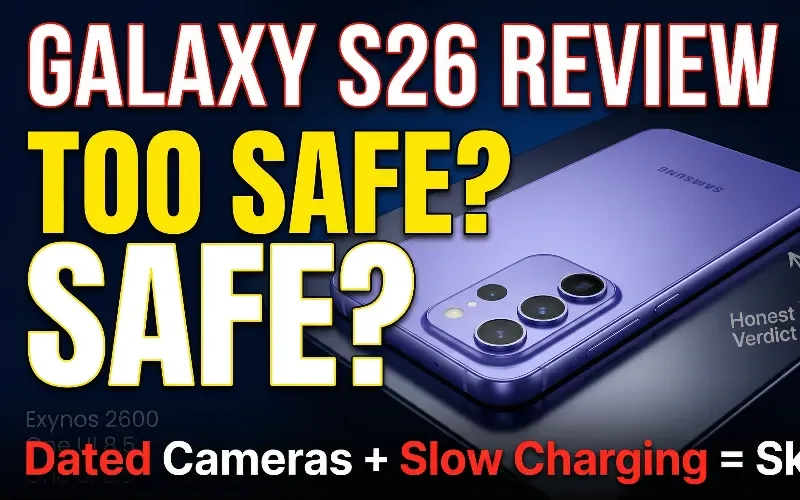

Samsung Galaxy S26 MSRP $899.00
A polished design, smooth software, and strong everyday performance make the Galaxy S26 easy to like, but its dated cameras, slow charging, and safe upgrades dull the appeal.
Pros and Cons
| Pros | Cons |
| Compact and comfortable flagship design | Camera hardware feels dated for the price |
| Bright, smooth AMOLED display with uniform bezels | 25W charging is hard to defend in 2026 |
| Exynos 2600 performs well in real-world use | Battery life is respectable, not reliable |
| One UI 8.5 remains one of Android’s richest software experiences | No magnet for Qi2 wireless charging |
Over the years, I’ve jumped from brand to brand, Android skin to Android skin, and ecosystem to ecosystem for my daily driver. But even when premium Galaxy phones were losing spec-sheet contests, they still had a soft spot in my heart. At its best, that made picking up the Galaxy S26 feel really familiar.
It nestled in my routine like an old favorite. The trouble is that familiarity only takes you so far.
With the Galaxy S26 Ultra drawing all attention towards it, Samsung’s other flagship models have seemingly faded into the background despite being more reasonable alternatives to the company’s $1,300 flagship.
They would all be in the shadow of that price increase: with it in play, the question looming over the entire phone is whether or not the Galaxy S26 remains a default choice for anyone who wants something compact and premium amongst Android devices, or if this is finally the year where sitting one out in favor of something like an iPhone 17 begins to make more sense.
Samsung Galaxy S26 Specifications
| Feature | Details |
| Dimensions | 149.6 x 71.7 x 7.2 mm |
| Weight | 167 g |
| Display | 6.3-inch LTPO AMOLED 2X, 120Hz, 2340 x 1080 at 411 ppi |
| Chipset | Exynos 2600 |
| RAM | 12 GB |
| Storage | 256 GB |
| OS | Android 16 based on One UI 8.5 |
| Rear Cameras | 50 MP main / 10 MP telephoto / 12 MP ultrawide |
| Front Camera | 12 MP |
| Battery and Charging | 4,300 mAh / 25 W wired / 15 W wireless |
Galaxy S26 Design: Looks Can Be Deceiving
Quick take: Samsung’s still the 2026 base flagship, now with new blingy camera bump.
On the surface, the Galaxy S26 is extremely similar to its predecessor. As for the thickness and weight, it’s almost identical, while most changes were executed in millimeters rather than a proper redesign. Turn it over, and Samsung clearly wants you to believe something larger has shifted. The raised camera housing borrowed from the Galaxy S26 Ultra gives the impression of investment in hardware.
There is not.
The new look helps refresh things a little, but it seems a bit disingenuous. Someone unfamiliar with the yearly routine at Samsung might mistake this for a far more camera-centric phone than it really is.
Galaxy S26 Design Highlights
| Aspect | Details | Rating |
|---|---|---|
| Size & Weight | 149.6 x 71.7 x 7.2 mm, 167 g | Excellent |
| Build & Materials | Glass back, metal frame, Gorilla Glass Victus 2 | Premium |
| New Design Element | Raised camera housing (Ultra-inspired) | Cosmetic only |
| Comfort & Ergonomics | Very comfortable, easy one-handed use | Very Good |
| Color Options | Cobalt Violet stands out | Best in lineup |
| Slipperiness | Extremely slippery without a case | Notable drawback |
| Durability | IP68 + Armor Aluminum 2 frame | Solid |
| Unboxing | No charger, no case, no screen protector | Barebones |
That being said, the fundamentals still hit nicely. It is a very nice and easy phone to use daily. You have a premium-feeling glass-and-metal mix, and with a relatively light body it’s one of the easier flagship phones to live with. I liked the Cobalt Violet color of the one Samsung lent over, too.
In my opinion, it’s comfortably the best color of the bunch and brings a more subdued kind of flair. I might even go so far to say it looks a little like the iPhone 17 Pro’s Deep Blue finish gave birth.
My only complaint is that, without a case, this phone is hilariously slippery; Add that slick finish to this light frame and the Galaxy S26 has a tendency to want to jump out of your hand at the first opportunity.
Samsung isn’t skimping on durability. You’re also getting Gorilla Glass Victus 2 on both the front and back, plus an Armor Aluminum 2 frame offering full IP68 water resistance.
Design Score: 7/10
Galaxy S26 Display: No Fancy Privacy Tricks, Just a Solid AMOLED
Quick Take: A smooth, bright, reliable panel with some of the polish that Samsung excels at.
Samsung has a knack for making great AMOLED panels, and the Galaxy S26 follows in that tradition. The phone sports a 6.3-inch Dynamic AMOLED 2X display now, as well, making it a taller device and closer in size to the iPhone 17. It still feels pleasantly compact and one-hand-friendly, especially relative to the far larger Galaxy S26 Ultra.

The screen can get up to 2,600 nits peak brightness, so visibility outdoors was never a problem. Matching bezels lends a sense of symmetry and polish. By default it pumps out vivid Samsung colors but you can change to a more natural profile. It even supports HDR10+ for robust streaming.
Galaxy S26 Display Breakdown
| Feature | Details | Rating |
|---|---|---|
| Size & Type | 6.3-inch LTPO AMOLED 2X, 120Hz | Excellent |
| Brightness | Up to 2,600 nits | Very Good |
| Resolution | 2340 x 1080 (411 ppi) | Good |
| Bezel Design | Uniform bezels | Polished |
| Color & HDR | Vibrant default, Natural option, HDR10+ | Strong |
| Sharpening Tech | ProScaler for text and images | Helpful |
| Fingerprint Sensor | Ultrasonic, fast and accurate | Reliable |
| Eye Care Features | No DC dimming or high-frequency PWM | Missing |
Still, it is not a perfect package. Unlike more affordable rivals like the OnePlus 15, Samsung skips eye-care features such as DC dimming or high-frequency PWM. On a phone at this price, that omission is worth noting.
Display Score: 7/10
Galaxy S26 Performance: Reconnecting with the Exynos
Quick take: Samsung’s Exynos return to form is far better than anticipated, and yet somehow still fails to sway the debate.
The Galaxy S26 series brought back the high-end Exynos chip from Samsung. Exynos flagships in the past have largely fell behind Snapdragon figures on matters of performance, efficiency, and thermals. The upgrade is palpable this time around.
It leaves a pretty decent first impression, with the Exynos 2600 built on the new 2nm process. It no longer decisively lags the Snapdragon 8 Elite Gen 5, though the gap isn’t embarrassing.
Galaxy S26 Performance Benchmarks
| Benchmark | Score | Notes |
|---|---|---|
| Geekbench 6 Single-Core | 3,036 | Strong |
| Geekbench 6 Multi-Core | 10,534 | Competitive |
| AnTuTu | 2,859,177 | Good GPU contribution |
| 3DMark Wild Life Extreme | 6,366 (38.13 fps) | Solid graphics |
| Stress Test Stability | 53.5% | Throttles under load |
Overall, the Exynos 2600 is a big step forward but does not completely erase past concerns.
Performance Score: 8/10
Galaxy S26 Battery: Samsung Pushes Power Optimization
Quick take: Great optimization helps, but the tiny battery and slow charging still feel out of place in 2026.
Chinese phones now pack huge batteries that easily last two days. The Galaxy S26 sticks with a modest 4,300 mAh cell. Thanks to strong software optimization, it performs better than expected, but it is still far from class-leading.
Galaxy S26 Battery & Charging
| Aspect | Details | Rating |
|---|---|---|
| Battery Capacity | 4,300 mAh | Small |
| Screen-on Time | Around 5+ hours (mixed use) | Respectable |
| Gaming Drain | ~25% per hour | Average |
| Wired Charging | 25 W (full charge over 1 hour) | Poor |
| Wireless Charging | 15 W (no Qi2 magnet) | Limited |
Lighter tasks like streaming and scrolling are fine, but heavy camera or gaming use drains the battery noticeably. Most days it gets through, but it is not carefree. For long days or travel, a power bank is still recommended.
The 25 W charging feels outdated in 2026, especially when even some Galaxy A-series phones charge faster. A full top-up takes over an hour.
Battery Score: 6/10
Galaxy S26 Cameras: New Generation, Aging Habits
Take: The primary snapper still makes the team look good, but the rest of the setup seems increasingly dated.
The camera hardware on the Galaxy S26 largely carries over from last year. In computing, improvements are gained through tuning and processing not hardware. The cameras are perfectly fine and capable for daily use, but by 2026 they don’t feel flagship-caliber.
The 50MP main sensor takes care of the heavy lifting with bright, colorful Samsung-esque photos that are perfect for posting to social media. Low-light shots are respectable but betray the hardware’s vintage. Video is also stable on the main camera, where there’s a new Horizon Lock feature that works surprisingly well.
Galaxy S26 Camera Performance
| Camera Type | Strength | Weakness | Overall |
|---|---|---|---|
| Main (50 MP) | Bright, vibrant, social-ready | Not always the sharpest | Good |
| Ultrawide (12 MP) | Versatile | Noticeable noise | Average |
| Telephoto (10 MP) | 3x zoom | Lags behind rivals | Average |
| Video | Stable 4K/60fps + Horizon Lock | Ultrawide/telephoto jittery | Decent |
| Selfies | Flattering warm tones | Less accurate skin tones | Good |
This setup is not bad, but it feels lazy. Samsung is still riding hardware from the Galaxy S22 era while relying heavily on image processing. For this price, a discounted Pixel 10 Pro often delivers a more convincing camera experience.
Camera Score: 6.5/10
Galaxy S26 Software: Samsung’s One UI 8.5 Has a Lot to Love
Quick take: One UI 8.5 remains one of Android’s richest software experiences, even if not every AI trick earns its place.
The Galaxy S26 runs One UI 8.5 on Android 16 and promises seven years of OS and security updates — one of the best support commitments in Android. It is smooth, polished, and feature-packed.

Galaxy S26 Software Highlights
| Feature | Details | Verdict |
|---|---|---|
| Software Skin | One UI 8.5 on Android 16 | Very Rich |
| Update Promise | 7 years OS + security updates | Excellent |
| Daily Feel | Fluid animations and effortless multitasking | Outstanding |
| Key Feature | Side panel for quick app access | Very Useful |
| Customization | Good Lock modules (Notistar, Sound Assistant) | Best in class |
| AI Features | Many options, some useful, some hit-or-miss | Mixed |
AI Everywhere… But Is It Anywhere Useful?
But hey, it is 2026, so Samsung has fully jumped on the AI bandwagon. Seems like a lot of features are familiar, either be borrowed from Google or highly inspired by Pixel phones.
Audio Eraser is different — it works in third-party apps, which is a real improvement. Call Screening feels very Pixel-esque, and Now Bar and Now Brief essentially split the “At a Glance” concept into two widgets.
Nudge, however attractive in theory, has proven unreliable. It largely works in messages and often does nothing at all. “Now Brief” promises a personalized daily summary but in practice comes off as underwhelming and data-hungry.
Some other AI tools such as Call Assist, Interpreter, and Writing Assist are helpful from time to time. Samsung’s added AI just about everywhere — photo editing, notification summaries and much more.
The big plus is privacy. All AI processing can remain on-device and you could allow permissions on a per-app basis or even shut features off entirely.
Gemini Automations is really cool when it works — you can just say, “book me an Uber to LAX,” and it takes care of the task in the background.
Samsung’s also great thanks to its Good Lock modules. But my two favorites are Notistar and Sound Assistant. For Galaxy S26 owners, a deep-dive into Good Lock is essential.
Software Score: 8/10
Final Take: Should You Buy the Samsung Galaxy S26?
The Galaxy S26 is one of those phones that, on paper at least, is pretty easy to like and a bit more challenging to recommend unqualified. Samsung absolutely nails the core experience in all the ways that have made Galaxy flagships feel trustworthy for years. It’s compact, premium, smooth and polished in a way that many rivals still can’t emulate.
The display is nice, the design comfortable and the Exynos 2600 is far more capable than most would have likely hypothesized. If we could reduce this down to day-to-day use, this is still a genuinely pleasant flagship.

But the fissures are becoming more difficult to ignore. The camera hardware is feeling stale, the battery life is over-decent but not quite impressive, and at this point in time, even the 25W charging feels borderline petty. Throw in the price increase, and the Galaxy S26 starts to look less like the no-brainer compact Android flagship and more like Samsung challenging you now to keep backing on familiarity alone.
If you already like what the Galaxy has to offer and want a flagship that’s not the size of your hand with one that just works, this still delivers. But if you were hoping for significantly more ambitious upgrades, or just better value compared to what the competition has been offering, then this is one of Samsung’s safest flagship releases in years — with at least some net impact that’s not necessarily a good thing.
Frequently Asked Questions
Why Not Try
Apple iPhone 17: If you’re looking for a well-rounded compact flagship with solid reliability as an everyday runner, the iPhone 17 will be the most obvious alternative, particularly if you already find yourself in Apple’s ecosystem.
Pixel 10: Another clean pick without going too overboard It’s not bringing any flashy specs, but it has the familiar brand polish with decent camera tuning.
Google Pixel 10 Pro: If there is one alternative to the Galaxy S26 that might be even more dangerous than this, right now it’s this. With Pixel 10 Pro prices already dropping in some markets, it starts to feel like the more “flagship” experience for this budget. Couple that with a competent camera system and recent discounts, and the Pixel 10 Pro makes for a worthy challenger.