In the early 1990s, the video game world was dominated by predictable genres. But then, a rebellious new title crashed the party. Road Rash wasn’t just a racing game; it was a high-speed, no-holds-barred brawl on two wheels. This brilliant combination of motorcycle racing and combat mechanics created a cultural phenomenon, defining a new genre and influencing countless games for decades to come.
It created a world that fans loved to explore, much like how audiences today pore over detailed maps of their favorite fantasy worlds to better understand the lore.
The core of every road rash game was simple: be the first to cross the finish line, using any means necessary. Over the years, the franchise evolved across different console generations, with each entry bringing its own flavor to the fight. Today, we settle the score by ranking the main entries in the series, from the frustrating misfires to the undisputed champion of combat racing.
The Criteria for Our Ranking
To create this definitive list, we evaluated each game based on the core characteristics that make a road rash game legendary:
- Gameplay & Controls: How tight are the racing mechanics and how satisfying is the combat?
- Innovation & Impact: Did the game introduce new ideas or perfect existing ones?
- Graphics & Sound: How well does the presentation capture the gritty, high-octane atmosphere?
- Overall Fun Factor: Does it deliver that addictive, “just one more race” feeling?
The Official Ranking of Every Road Rash Game
6. Road Rash: Jailbreak (2000) – The Failed Revival
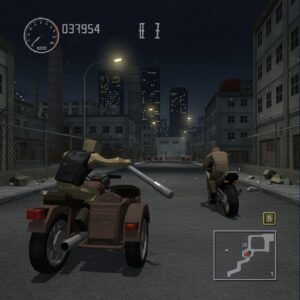
By the year 2000, the franchise needed a modern update. Released for the PlayStation, Jailbreak attempted to reboot the series with a heavy focus on story and new gameplay modes, moving away from the simple arcade ladder of the originals.
Defining the Gameplay
This entry introduced a narrative-driven campaign where players joined a gang to complete specific missions. Its most unique feature was the “Jailbreak” mode, featuring a motorcycle and sidecar. One player would drive while the other handled combat, creating a cooperative but ultimately awkward experience.
Verdict: Why It Ranks Last
Jailbreak is a classic example of a sequel that loses the spirit of the original. By focusing on a clunky story and experimental modes, it sacrificed the pure, chaotic fun that fans loved.
- Strengths:
- Ambitious attempt at a deeper story mode.
- The sidecar concept was a novel, if flawed, idea.
- Weaknesses:
- Sluggish and unresponsive controls.
- Muddy, unimpressive graphics for its time.
- Lost the essential arcade feel of the series.
5. Road Rash 64 (1999) – The Chaotic 3D Detour
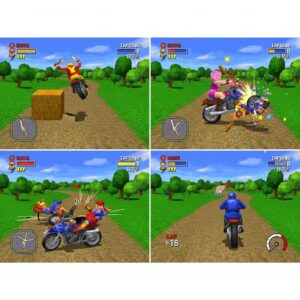
As the gaming world moved to 3D, Road Rash 64 brought the fight to the Nintendo 64. This entry was known for its four-player split-screen mode and an exaggerated, almost cartoonish style that set it apart from the grittier tone of its predecessors.
Defining the Gameplay
This was the most over-the-top game in the series. The physics were absurd, sending riders flying hundreds of feet. The focus was less on technical racing and more on creating absolute multiplayer mayhem, which made it a popular party game for the N64.
Verdict: A Fun but Flawed Party Game
While its multiplayer mode provided hours of chaotic fun with friends, the single-player experience felt shallow and unpolished, making it a weak entry in the overall road rash game library.
- Strengths:
- Excellent four-player mode that was chaotic and fun.
- Hilarious, over-the-top physics engine.
- Weaknesses:
- Clunky controls and a frequently dropping framerate.
- The cartoonish style was a jarring departure for many fans.
- Lacked the depth of other titles in the series.
4. Road Rash 3 (1995) – The Safe World Tour

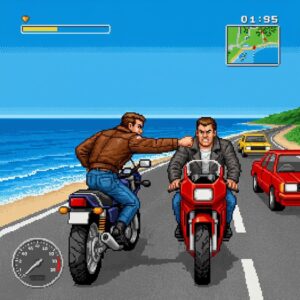
The final 16-bit entry, Road Rash 3, expanded the race to a global scale. Players could now battle across tracks in diverse locations like the UK, Kenya, and Brazil, adding new scenery to the familiar motorcycle combat.
Defining the Gameplay
Road Rash 3 was more of a refinement than a revolution. It added a few new weapons (like nunchaku) and introduced bike upgrades, allowing players to improve their machine’s performance. The core gameplay, however, remained nearly identical to Road Rash II.
Verdict: More of a Good Thing
While still an excellent game, it didn’t innovate enough to surpass its predecessor. It felt more like a large expansion pack than a true sequel, playing it safe instead of pushing boundaries.
- Strengths:
- Great track variety with international locations.
- Introduction of bike upgrades added a new strategic layer.
- Weaknesses:
- Felt too similar to Road Rash II.
- The graphics and engine were showing their age on the Sega Genesis.
3. Road Rash (1991) – The Revolutionary Original

This is the game that started it all. The original Road Rash on the Sega Genesis was a groundbreaking title that single-handedly created the combat racing sub-genre. Its simple premise of racing and fighting across California highways was executed to perfection.
Defining the Gameplay
The first road rash game established the core mechanics: race, fight, and earn cash for faster bikes. Players had to master the timing of punches and kicks while navigating traffic and avoiding the police. It was a pure, addictive, and incredibly fresh concept.
Verdict: A Timeless Classic
Though later games would refine its formula, the original’s raw innovation and perfect execution of a new idea make it an undeniable classic. It laid the foundation for every game that followed.
- Strengths:
- A completely original and groundbreaking concept.
- Perfectly balanced risk-vs-reward gameplay.
- Weaknesses:
- Limited track and weapon variety compared to sequels.
- Graphics and sound are not up to Today standards.
2. Road Rash (1994) – The Grungy Next-Gen Leap
Released on 32-bit consoles like the 3DO, Saturn, and PlayStation, this version of Road Rash was a gritty, atmospheric reboot. It used digitized sprites, full-motion video (FMV) cutscenes, and an incredible licensed soundtrack to perfectly capture the 90s counter-culture vibe.
This leap to a new console generation was a huge deal, sparking the same kinds of debates gamers have today when they ask if a new piece of tech like the iPhone 17 is worth the upgrade over previous models.
Defining the Gameplay
This was the most immersive road rash game to date. The FMV cutscenes introduced a cast of rival racers with unique personalities, and the licensed soundtrack featuring bands like Soundgarden became iconic. The racing felt faster and more visceral, making for an intense experience.
Verdict: An Atmospheric Masterpiece
This version took the series’ rebellious spirit to the next level. The combination of polished gameplay and one of the best soundtracks in video game history makes it a high point for the franchise and a perfect time capsule of 90s culture.
- Strengths:
- Incredible licensed grunge and rock soundtrack.
- Immersive atmosphere with memorable characters and FMVs.
- Weaknesses:
- Long loading times on the CD-based consoles.
1. Road Rash II (1992) – The Perfected Formula
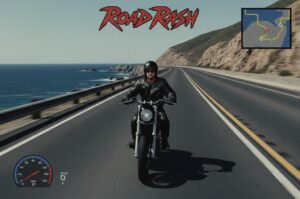
If the first game was the brilliant idea, Road Rash II was its flawless execution. It took every element of the original and improved upon it, creating what is widely considered the pinnacle of the series and a masterclass in game design.
Defining the Gameplay
Road Rash II introduced two game-changing features: the iconic chain weapon and a fantastic two-player split-screen mode. The new tracks, set across states like Alaska and Arizona, offered more variety, and the controls felt tighter and more responsive than ever before.
Verdict: The Undisputed Champion of Combat Racing
This is the definitive road rash game. The addition of split-screen multiplayer provided endless replayability and cemented its legendary status. It achieved the perfect balance between arcade racing and combat, creating an experience that has never been duplicated.
- Strengths:
- The gold standard for combat racing gameplay.
- Legendary two-player split-screen mode.
- Introduced the iconic chain weapon.
- Weaknesses:
- Its only limitation was the 16-bit hardware it was built on.
[post_faqs]
The Enduring Legacy of the Road Rash Game Franchise
The Road Rash series was more than just a collection of games; it was an attitude. Its legacy is not just in its innovative gameplay but in the rebellious spirit it embodied. From the 16-bit pixelated highways to the grungy, CD-powered soundtracks, these games captured a unique feeling of freedom and danger.
This influence is still felt today. Modern titles like Road Redemption are direct spiritual successors, proving that the demand for high-speed motorcycle combat is still very much alive. While the future of the official franchise remains uncertain, the impact of Road Rash is undeniable. It will forever be remembered as the undisputed king of the road.