The Meze Audio Strada is the kind of headphone you don’t expect to be this good at its price. Sharing its driver DNA (a single dynamic in a wide-bore enclosure) with the 109 Pro open-back, as well as some of the upper-tier silhouette and wood-and-magnesium craftsmanship of our recently reviewed $2,000 Liric II: The Strada lands at $799 and instantly engenders the question: What’s the catch?
Having listened extensively across a range of sources and genres, we can tell you that the answer is complex. But let’s begin where it counts the most.
Quick Verdict: Meze Audio Strada at a Glance
| Feature | Meze Audio STRADA |
|---|---|
| Type | Closed-back, wired over-ear |
| Driver | 50mm dynamic (derived from 109 Pro) |
| Frequency Response | 5Hz – 30kHz |
| Impedance | 4 ohms |
| Sensitivity | 111dB (SPL/mW @ 1kHz) |
| Weight | 332g (without cable) |
| Cables Included | 2x 1.8m braided Kevlar OFC (3.5mm + 4.4mm balanced) |
| Ear Pads | Magnetic, memory foam, PU leather |
| Frame | Magnesium, hand-painted in four coats |
| Ear Cups | Macassar ebony hardwood |
| Case | Rigid EVA travel case |
| Price | $799 / £799 / AU$1,499 |
Best for: Audiophiles who need closed-back isolation without sacrificing soundstage and tonal neutrality.
Skip if you have a smaller head, prefer visceral bass impact over refinement, or need wireless functionality.
What’s the Meze Audio Strada? Understanding the Lineup
For as long as he’s been in business, Antonio Meze—creator of, among other things, headphones that re-create the experience of playing a beloved Fender Stratocaster guitar—hasn’t had an entry like this in his closed-back catalog.
At one end were the Meze 99 Classics (with its new V2), a warm, musical, entry-level closed back. The other is the no-holds-barred Liric II, a $2,000 planar magnetic flagship. Between them? Nothing — until now.
The Strada intentionally lurks between the two, copping something from across the Meze catalog:
- Driver technology: Borrowed from (and based on) the 109 Pro open-back
- Physique: Derives from Lyric II underpinnings
- Tone: Fitted with the more muted, sophisticated Silva/AER lines
The end result is a headphone that manages to feel like, both, an evolution and something very new for anyone familiar with the Meze catalog.
Design & Build: Gorgeous, Green, and Generously Sized
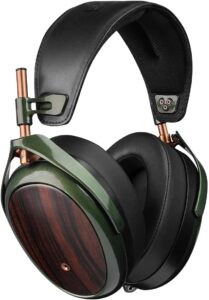
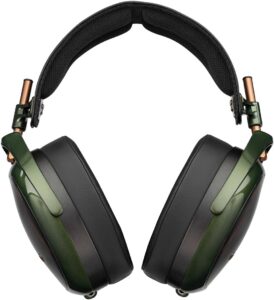
Now, let’s get that elephant in the room out of the way: the Strada is big. The adjustment rod mechanism shifts with a fit that goes from “huge” to “very large indeed” and will probably not be comfortable or practical for those of you with smaller heads. That is a legitimate limitation, and it’s beneficial to know that before you plunk down $799.
For the rest of us, it’s really well made.
The magnesium tub is hand-painted in four coats of a dark, slightly metallic color that anyone familiar with motor racing history will identify without hesitation as a close relative of British Racing Green. It’s offered in the color only—and it’s a genuinely beautiful and unique look that stands out from the ocean of matte-black cans.
The ear cup covers are made from Macassar ebony hardwood, which has natural grain patterns that ensure no two Stradas will look the same. The interplay between the darker wood and the metallic green frame is warm without being too retro; their combined aesthetic seems more like a luxury object than audio equipment.
The earpads are deep and plush memory foam, covered in PU leather, that can be removed with magnets for easy maintenance. The broad, fabric-lined headband, which employs a cross-pattern suspension to permit airflow and dissipate heat buildup across the ear pads, also makes the Strada genuinely comfortable for longer listening sessions—if it fits your head, that is.
A real weakness: the cable transmits mechanical noise. Touch, ping, or bump the braided Kevlar OFC cable during listening, and it manifests clearly through the headphones. This is not unique to the Strada, but it is more obvious here than with many wired rivals. The moral of the story: be still or use a cable management solution.
Driver Technology: The 109 Pro’s Heart in a Closed Shell
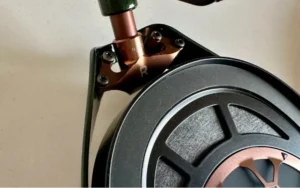
The large(ish) 50mm dynamic driver in the Strada is where most of Meze’s real engineering talent has injected genuine effort, and the specifications are impressive considering this isn’t exactly a high-end premium price point.
The W-shaped dome is made from a lightweight but strong material that combines carbon fiber and cellulose, designed to reduce unwanted sounds that can cause distortion. The dome ring is composed of a special beryllium-coated plastic that strengthens it without adding considerable weight to the enclosure, and strategically placed grooves cut around the toroid enable better performance.
A copper-zinc alloy stabilizer that encircles the membrane absorbs superfluous vibrations and suppresses distortion even more.
The resulting frequency response—5 Hz to 30 kHz—is bold, and the 4-ohm impedance is not so hard to drive. Still, with an 111dB sensitivity rating to play with, you’re going to want a decent DAC or digital audio player feeding these modded cans if you want the best performance. Any phone with a headphone jack will do, but the Strada pairs really well with a desktop DAC/amp combo for something high-end or any portable such as an iBasso DX340 for much more depth and control.
Sound Quality: Unexpectedly Open, Precisely Controlled
Here’s the thing about closed-back headphones: they usually sound like them. Intimate, somewhat constrained, direct. The Strada is, to a remarkable degree, an exception.
Soundstage & Imaging
In our testing, the Strada creates a soundstage that is genuinely wide and well-organized for a closed-back design. Instrument separation is consistently clean — everything occupies a defined space and moves within the stereo field with natural articulation.
The width of that soundstage does vary with the recording. On richly produced material, the Strada opens up impressively. On simpler, more intimate tracks — like Elliott Smith’s delicately picked acoustic guitar work — they pull you close in a way that feels intentional and communicative rather than claustrophobic.
Tonal Balance
Tonally, the Strada aims for neutrality and largely achieves it. There’s a slight warmth at the lowest frequencies, a deep and well-controlled sub-bass presence, and a midrange that is clean and articulate without being forward or fatiguing. Vocals in particular have a natural, uncolored quality.
The treble has genuine air and shimmer—some reviewers find it elevated, and listeners sensitive to upper-treble energy should ideally audition these before buying. In our experience, the treble extends well without becoming harsh on well-recorded material, though busy recordings can occasionally feel slightly busy at the top end.
Dynamics & Musical Versatility
The Strada has an impressive dynamic range—it handles the vast distance between a whispered passage and a full orchestral climax convincingly. It’s also genuinely versatile across genres: jazz, classical, folk, and electronica all sound balanced and intelligently reproduced.
The one consistent criticism—and it’s a fair one—is that Strada errs toward refinement even when the music calls for rawness. Rock, punk, and more aggressive genres get reproduced with technical accuracy, but the Strada’s polished character subtly smooths over the rough edges that give those genres their energy. If you prefer a model that delivers your music with controlled sophistication, you’ll love this one. If you want it to hit hard, you may wish the Strada would stop interfering.

Meze Audio Strada vs. The Competition
Strada vs. Meze 109 Pro ($799)
The 109 Pro uses a closely related driver in an open-back configuration at a similar price. It trades isolation for an even more open, effortless soundstage. If you don’t need closed-back isolation, the 109 Pro is a worthy alternative — but the Strada holds its own.
Strada vs. Meze Liric II ($2,000)
The Liric II uses planar magnetic technology, which accounts for most of the price difference. Both share a design platform, but the Liric II offers higher technical resolution. The Strada sounds like it costs considerably more than $799 — it doesn’t sound like it costs $2,000.
Strada vs. Audio-Technica ATH-W1000 (~$599)
The ATH-W1000 is a genuine alternative at a lower price point, with its own hardwood aesthetic and strong build quality. The Strada edges ahead in soundstage size and tonal neutrality, but the ATH-W1000 offers better value for budget-conscious buyers.
Strada vs. Audeze LCD-2 (~$799)
The LCD-2 is a planar magnetic competitor at roughly the same price. It offers different sonic priorities — a warmer, weightier low end versus the Strada’s more neutral, refined character. Both are strong; which one wins depends entirely on your preference.
| Strada | 109 Pro | Liric II | ATH-W1000 | |
|---|---|---|---|---|
| Type | Closed, dynamic | Open, dynamic | Closed, planar | Closed, dynamic |
| Price | $799 | $799 | $2,000 | ~$599 |
| Isolation | Good | None | Excellent | Good |
| Soundstage | Wide for closed | Very wide | Wide | Moderate |
Who Should Buy the Meze Audio Strada?
Buy it if you:
- Need closed-back isolation but refuse to sacrifice soundstage
- Appreciate neutral, refined sound over colored or bass-boosted tuning
- Value exceptional build quality and handcrafted materials
- Have a well-fitting head (medium to large) and a quality source to pair it with
- Want a headphone that looks unlike anything else in your collection
Skip it if you:
- Have a smaller head—the fit will genuinely frustrate you
- Primarily listen to rock, metal, or genres where raw energy matters most
- Need wireless connectivity of any kind
- Are sensitive to upper-treble brightness
Frequently Asked Questions (FAQ)
Also Read:
- Jabra Evolve3 85 Review: Boomless Work Headset for Hybrid Pros
- Samsung Galaxy S26 Review: This Compact Flagship Feels Too Safe
- Best Airlines for Long Flights: 2026 Guide to Comfort and Sleep
First reviewed: April 2026. Pricing based on Sweetwater, Crutchfield, and Best Buy listings.